
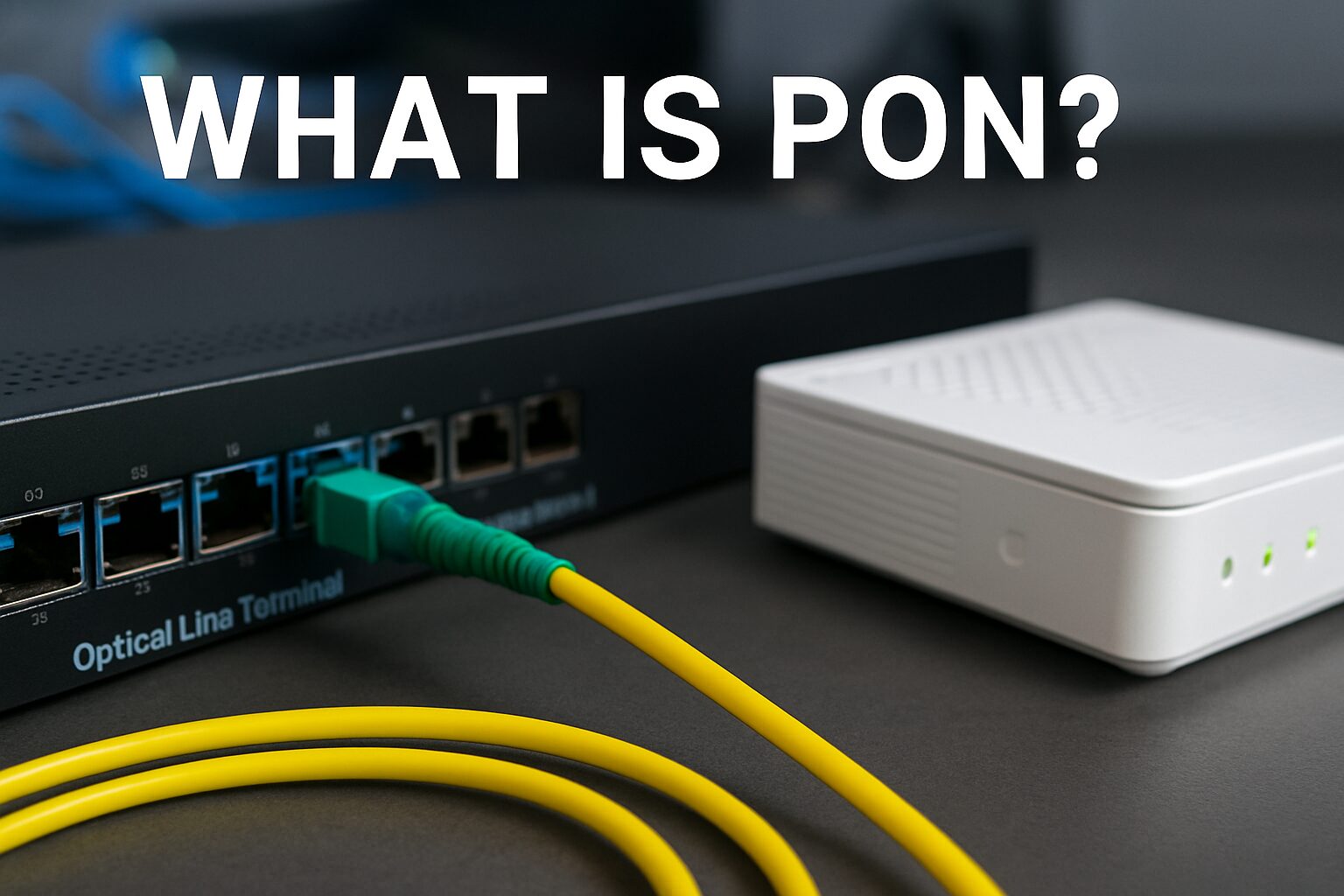
PON, or Passive Optical Networking, is a type of fiber-optic network that uses passive components to deliver high-speed internet from a central office to homes, buildings, and enterprises. “Passive” means that the network does not require electrical power between the main distribution point and the user.
Why PON Matters Today
As internet usage increases—video streaming, cloud storage, mobile apps, IoT devices—traditional copper networks can no longer keep up. PON offers:
- Faster speeds
- Better reliability
- Lower maintenance
- Future-proof fiber infrastructure
How PON Differs From Traditional Networks
PON uses fiber-optic cables for faster speeds and longer distances, unlike slower copper networks. It’s a passive system with no powered equipment between provider and user, reducing costs and maintenance. PON also allows shared bandwidth among multiple users, making it more scalable and efficient than traditional dedicated-line networks.
How PON Works
A Passive Optical Network (PON) works by using a single fiber-optic line from the service provider that splits into multiple connections to serve many users. The “passive” part means there are no powered devices between the provider and the end users; instead, optical splitters divide the signal efficiently.
Data travels as light pulses through the fiber, allowing high-speed internet, voice, and video services over long distances. Each user receives a portion of the bandwidth, and advanced protocols ensure signals are sent and received without interference. This setup reduces maintenance, lowers costs, and delivers fast, reliable connections to homes and businesses.
benefits of PON
Passive Optical Network (PON) technology offers several advantages that make it an ideal choice for modern broadband. It delivers high-speed and stable internet, supporting streaming, gaming, and business applications with minimal lag. PON is also cost-efficient, as multiple users share a single fiber line, reducing infrastructure and maintenance expenses compared to traditional copper networks. Its scalability allows providers to add more users or increase speeds without replacing the entire system. With energy-efficient passive components, PON lowers operational costs, while its reliability and security—being less prone to interference and harder to tap into—ensure a consistent and safe connection for homes and businesses.
Key Components of a PON Network
Optical Line Terminal (OLT)
The OLT acts as the “brain” of the network. It:
- Connects PON to the internet backbone
- Manages traffic for all ONTs
- Controls upstream scheduling
Optical Network Terminal (ONT/ONU)
The ONT is the device found in the home or office. It:
- Converts optical signals into data that devices can use
- Handles internet, phone, and TV services
- Sends data upstream to the OLT
Optical Distribution Network (ODN)
The ODN includes all the fiber cables, splitters, and connections that physically link the OLT to the ONTs.
Splitters and Fiber Cables
Splitters divide a single fiber into multiple connections, which lowers the cost for providers. They come in different split ratios such as 1:16 or 1:64 depending on capacity.
Different PON Standards
PON has evolved over the years to support higher speeds and better performance.
APON / BPON
- Early PON standard
- Speeds: ~622 Mbps
- Mostly outdated today
GPON (Gigabit PON)
- One of the most widely used PON standards
- Speeds: 2.5 Gbps downstream / 1.25 Gbps upstream
- Good for FTTH, FTTB, and enterprise broadband
EPON (Ethernet PON)
- Uses Ethernet protocol
- Speeds: 1 Gbps symmetrical
- Common in Asian markets
10G-PON / XG-PON / XGS-PON
- Supports 10 Gbps downstream speeds
- XGS-PON offers symmetrical 10 Gbps
- Ideal for smart cities, business parks, data centers, and heavy-demand users
Comparison Table (Simplified)
| PON Type | Downstream Speed | Upstream Speed | Best For |
|---|---|---|---|
| BPON | ~622 Mbps | ~155 Mbps | Very old networks |
| GPON | 2.5 Gbps | 1.25 Gbps | FTTH, SMEs |
| EPON | 1 Gbps | 1 Gbps | Ethernet-based markets |
| XG-PON | 10 Gbps | 2.5 Gbps | High-traffic networks |
| XGS-PON | 10 Gbps | 10 Gbps | Enterprises & ISPs |
Visual Insight: PON Adoption Growth (2020–2025)
(Sample Graph Representation)
Year      Global PON Adoption (%)
2020      ██████████ 35%
2021      █████████████ 45%
2022      ████████████████ 55%
2023      ███████████████████ 65%
2024      ██████████████████████ 72%
2025      █████████████████████████ 80%
Insight: By 2025, nearly 80% of new fiber deployments worldwide use PON, especially GPON and XGS-PON.
Benefits of Using PON Technology
Passive Optical Network (PON) technology offers several advantages that make it a popular choice for modern internet and telecom services. One of its biggest benefits is high-speed data transmission, allowing providers to deliver fast and stable internet connections over long distances using fiber-optic cables. PON also supports multiple users on a single network without active electronic components in the distribution path, which reduces power consumption and lowers maintenance costs.
Another key benefit is scalability. PON networks can easily be upgraded to support higher speeds and more users without replacing the entire infrastructure. They also provide better reliability and security compared to traditional copper networks, as fiber is less affected by interference and harder to tap into. Overall, PON technology enables faster, more efficient, and cost-effective broadband services for homes and businesses.
Common Applications of PON
Fiber-to-the-Home (FTTH)
The most popular use case. It delivers high-speed internet directly to residential homes.
Fiber-to-the-Building (FTTB)
Ideal for apartments, hotels, schools, and commercial buildings.
Business Broadband
Companies use PON to support cloud computing, video conferencing, and large-scale operations.
Smart City Infrastructure
Supports traffic monitoring, public WiFi, IoT devices, sensors, and emergency systems.
CCTV and Surveillance Networks
PON’s long-distance fiber coverage is perfect for connecting far-away cameras with minimal delay.
PON vs. AON (Active Optical Networks)
Key Differences
| Category | PON | AON |
|---|---|---|
| Power Requirement | No mid-point power | Requires powered switches |
| Cost | Lower | Higher |
| Maintenance | Minimal | More maintenance |
| Distance | Longer reach | Shorter |
| Reliability | Better | Depends on powered devices |
Pros and Cons
PON Pros:
- Lower cost
- Energy-efficient
- Simple design
- High scalability
PON Cons:
- Shared bandwidth
- Split ratio limits
When PON Is the Better Choice
PON works best for:
- Residential fiber
- Small and medium businesses
- Rural deployments
- Smart cities
- Any area needing cost-effective fiber rollout
Challenges and Limitations of PON
While Passive Optical Network (PON) technology offers many benefits, it also comes with some challenges and limitations. One major drawback is the high initial setup cost. Installing fiber-optic cables and upgrading existing infrastructure can be expensive, especially in rural or hard-to-reach areas. Another limitation is shared bandwidth. Since multiple users share the same fiber line, network performance can slow down during peak usage times if the network is not properly managed. Troubleshooting can also be more complex because a single fault in the fiber line may affect multiple users at once.
PON systems also require specialized equipment and skilled technicians for installation and maintenance. Additionally, physical damage to fiber cables can be harder and more costly to repair compared to copper lines. Despite these challenges, many providers still choose PON due to its long-term efficiency and scalability.
The Future of PON Technology
Rise of 10G-PON and Beyond
Many providers are migrating to XGS-PON to support:
- 5G backhaul
- Large business complexes
- Data-intensive smart city services
PON in 5G and IoT Ecosystems
PON can easily support massive device connectivity required by IoT deployments and 5G networks.
Trends in Fiber Deployment
- Rapid growth in FTTH
- Governments funding rural fiber expansion
- Smart homes and AI-driven technologies demanding stronger networks
PON will remain the backbone of next-generation broadband.
Conclusion
PON, or Passive Optical Networking, is more than just a fiber technology—it’s the foundation of modern high-speed connectivity. With its passive design, high bandwidth capacity, cost-efficiency, and future-proof structure, PON continues to power homes, businesses, and smart cities worldwide. If you’re exploring FTTH deployment, upgrading your business broadband, or planning smart city infrastructure, PON is a reliable and scalable choice.
Frequently Asked Questions (FAQs)
1. What does PON mean?
PON stands for Passive Optical Networking, a fiber network that uses passive splitters to deliver high-speed internet.
2. Is PON better than AON?
Yes, PON is more cost-effective, energy-efficient, and easier to maintain than AON.
3. What is the speed of GPON?
GPON supports 2.5 Gbps downstream and 1.25 Gbps upstream.
4. What is an ONT?
An Optical Network Terminal is a device placed at homes or offices to convert optical signals into usable data.
5. How far can PON reach?
Up to 20 km depending on network design and splitter configuration.
6. What is XGS-PON?
A next-gen PON standard offering 10 Gbps symmetrical speeds.
7. Why is PON used in smart cities?
Its long-range fiber and high reliability are perfect for CCTV, sensors, and public networks.
8. Can PON support business broadband?
Yes, PON is widely used for enterprise connections due to its high stability and scalability.
9. Does PON require electricity?
Only the OLT and ONT need power. The network in between is completely passive.
10. Is PON future-proof?
Yes. PON infrastructure can support upgrades from GPON to XGS-PON and beyond without replacing the fiber.
Disclaimer
The information provided in this article is for general educational purposes only. Technical specifications, standards, and performance may vary depending on equipment, service providers, and deployment environments. Always consult certified fiber specialists or network engineers for professional advice.



Thank you for this insightful piece. It’s given me a lot to think about.