
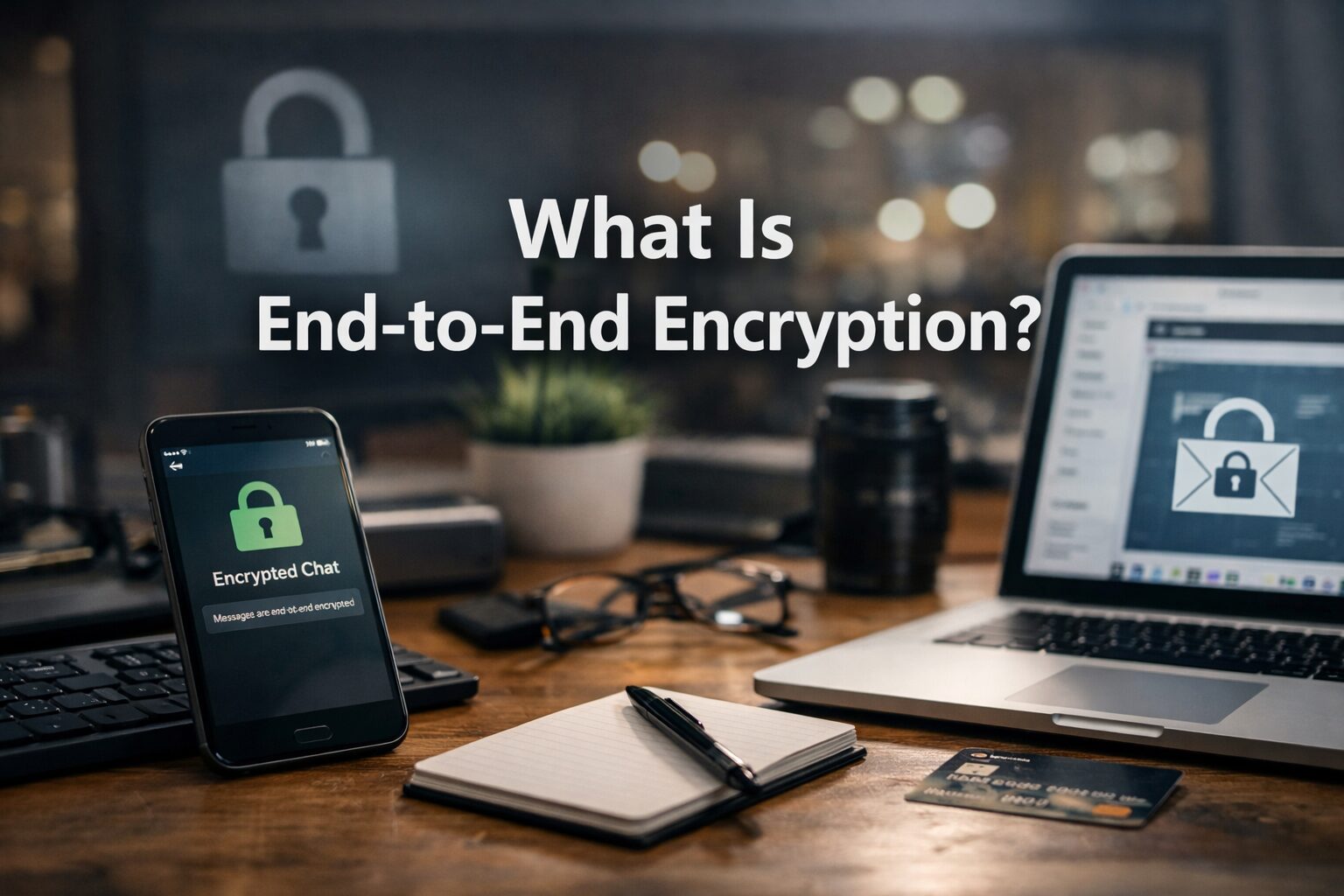
Every day, we send messages, emails, photos, passwords, and payment details online. From chatting with friends to logging into bank accounts, our personal data is constantly moving across the internet. This makes digital privacy and data security more important than ever. So, what is end-to-end encryption? It is a security method that ensures only the sender and receiver can read the data, keeping your information safe from hackers, service providers, and other third parties.
Cyberattacks, data leaks, and online spying are rising worldwide. Hackers target weak systems, and even trusted platforms can suffer breaches. That’s why encryption plays a huge role in keeping information safe.
So, what is end to end encryption?
In simple terms, end-to-end encryption (E2EE) is a security method that ensures only the sender and the receiver can read the data. No one else—not hackers, internet providers, governments, or even the app itself—can access the message. In today’s online world, where privacy is often at risk, encryption is no longer optional. It’s a necessity.
What Is End-to-End Encryption?
End-to-end encryption is a security method that keeps data private by making sure only the sender and the receiver can read it. The sender encrypts information on their device and the data remains encrypted during its transmission across the internet. The data becomes decrypted only when it arrives at its designated recipient. This prevents hackers, internet providers, and governments from accessing the content, including the service or app being used. End-to-end encryption is commonly used in secure messaging apps, email services, and financial platforms to protect sensitive and personal information.
How End-to-End Encryption Works
End-to-end encryption protects data starting from its transmission through the sender’s device until it arrives at the intended receiver.Your device uses a special encryption key to encrypt your message or file which you send. The encrypted data travels across the internet as unreadable code which prevents understanding even when someone intercepts it. The receiver uses a private key that only he possesses to decrypt the data.
The service provider cannot access private keys so only the sender and receiver can read the information which maintains complete security for their communication.
Encryption in Transit vs End-to-End Encryption
| Feature | Encryption in Transit | End-to-End Encryption |
|---|---|---|
| Data encrypted while sending | ✅ | ✅ |
| Service provider can read data | ✅ | ❌ |
| Strong privacy protection | ❌ | ✅ |
Encryption in transit protects data while moving, but the service can still access it. End-to-end encryption removes that risk.
What kind of encryption does E2EE use?
End-to-end encryption (E2EE) typically uses a combination of asymmetric (public-key) encryption and symmetric (private-key) encryption to secure data.
- Asymmetric Encryption: This involves a pair of keys—a public key to encrypt the message and a private key to decrypt it. The sender uses the receiver’s public key to lock the message, and only the receiver’s private key can unlock it. This ensures that only the intended recipient can read the data.
- Symmetric Encryption: Once the connection is established, E2EE often uses a shared session key to encrypt the actual message content. Symmetric encryption is faster and efficient for encrypting large amounts of data.
By combining these two methods, E2EE ensures strong security, privacy, and performance, keeping messages, files, and sensitive information safe during transmission.
How End-to-End Encryption Works
Role of Encryption Keys
End-to-end encryption relies on encryption keys:
- Public key – Used to lock the message
- Private key – Used to unlock the message
Your private key stays on your device and is never shared.
Step-by-Step Encrypted Communication
- You write a message
- The app encrypts it using the receiver’s public key
- The message travels across the internet as unreadable code
- The receiver’s private key decrypts the message
- The message is displayed in plain text
Why Only Sender and Receiver Can Read It
Because only the receiver owns the private key, no third party can unlock the message—not even the platform hosting the service.
End-to-End Encryption vs Other Types of Encryption
End-to-End Encryption vs Standard Encryption
Standard encryption protects data but allows service providers to access it. End-to-end encryption removes that access completely.
End-to-End Encryption vs Client-Server Encryption
| Feature | Client-Server | End-to-End |
|---|---|---|
| Server can read messages | ✅ | ❌ |
| Strong privacy | ❌ | ✅ |
| Best for sensitive data | ❌ | ✅ |
Pros and Cons Comparison
Pros
- Maximum privacy
- Strong protection against hacking
- No third-party access
Cons
- Harder to recover lost data
- Legal and regulatory concerns
- Slightly more complex systems
Benefits of end-to-end encryption
End-to-end encryption delivers major advantages for both privacy protection and data security. The system protects all messages and files by allowing only the authorized sender and receiver to access them while blocking all other parties. The system establishes strong protection which decreases the possibilities of data breaches and identity theft and financial fraud. Users who choose E2EE services can send messages without doubt because their data will remain private and protected.
The system protects users from third-party surveillance which includes both advertisers and government entities so it becomes essential for people to use it in their personal and financial and business communications.
limitations of end-to-end encryption
End-to-end encryption (E2EE) delivers strong privacy and security protections to users yet it contains certain weaknesses. The primary problem with E2EE exists because users who lose their encryption keys and passwords cannot retrieve their data. E2EE creates difficulties for law enforcement and regulatory bodies because it prevents them from accessing necessary information during investigations. The system introduces usability and performance issues which include two problems: users will experience slower message delivery and face more difficult system configurations.
E2EE fails to provide protection against device-level threats which include malware and phishing attacks because any compromised device will allow unauthorized access to encrypted data. The privacy advantages of end-to-end encryption protect user information more effectively than the security disadvantages of the system.
Why End-to-End Encryption Matters for Data Privacy
Protection Against Hackers and Data Breaches
If hackers break into a server, encrypted data is useless without the keys. This greatly reduces the risk of identity theft and fraud.
Prevention of Third-Party Access
Even service providers can’t read your messages. This protects users from:
- Data selling
- Surveillance
- Unauthorized data use
Importance for Personal, Financial, and Business Data
End-to-end encryption is critical for:
- Online banking
- Medical records
- Business communication
- Private messaging
Without it, sensitive data is exposed to serious risks.
Use cases for end-to-end encryption
End-to-end encryption (E2EE) has many practical use cases across personal, business, and industry settings where privacy and security are critical. Some common examples include:
- Messaging Apps – Platforms like WhatsApp, Signal, and Telegram (Secret Chats) use E2EE to keep private conversations secure from hackers and even the app providers.
- Email Communication – Services that offer end-to-end encrypted email protect sensitive correspondence, such as business contracts or personal messages, from unauthorized access.
- Cloud Storage – E2EE ensures that files stored in the cloud, like documents, photos, or financial records, remain encrypted and inaccessible to anyone except the owner and authorized recipients.
- Banking and Financial Transactions – Online banking apps and payment platforms use E2EE to secure sensitive data, including account numbers, transactions, and passwords, from cyber threats.
- Healthcare and Medical Records – E2EE protects patient records and communication between doctors and patients, ensuring confidentiality of personal health information.
- Business Communication – Companies use E2EE for internal messaging, confidential emails, and file sharing to protect trade secrets, contracts, and strategic plans.
Any situation where sensitive information is shared digitally can benefit from end-to-end encryption to maintain privacy and security.
Real-World Examples of End-to-End Encryption
Messaging Apps Using E2EE
Popular secure messaging apps include:
- Signal
- Telegram (Secret Chats)
These apps ensure private conversations stay private.
Email and Cloud Services with E2EE
Some secure email and storage services offer full end-to-end encryption, protecting files and messages from unauthorized access.
Use Cases Across Industries
- Banking: Secure transactions
- Healthcare: Protect patient records
- Businesses: Safe internal communication
Benefits of End-to-End Encryption
End-to-end encryption provides multiple essential advantages which safeguard your data and privacy rights. The system protects data through its strong confidentiality measures which restrict access to messages and files between only designated sender and receiver. The system protects sensitive data from unauthorized access by hackers and cybercriminals and service providers. Users trust applications which protect their privacy more than they trust other platforms.
The system protects personal financial and business data through its ability to decrease both surveillance activities and data breaches. Digital end-to-end encryption functions as an essential instrument for protecting personal information in the modern online environment.
Limitations and Challenges of End-to-End Encryption
End-to-end encryption provides strong protections for privacy rights but introduces multiple restrictions and operational difficulties. The primary challenge exists because users who lose their passwords or encryption keys will be unable to access their data. The second problem arises from law enforcement agencies facing difficulties in conducting investigations because criminals use encrypted communication systems to hide their activities.
Users experience usability problems because end-to-end encryption requires them to handle complicated procedures for both installation and account administration. The system may experience a performance drop which occurs only in uncommon situations and affects mainly users of outdated technology. People prefer end-to-end encryption despite its difficulties because they believe its privacy advantages make up for all its negative aspects.
Is End-to-End Encryption Always Necessary?
When E2EE Is Essential
- Private messages
- Financial transactions
- Sensitive personal data
When Other Encryption May Be Enough
- Public content
- Non-sensitive information
How to Choose Secure Platforms
Look for:
- Clear privacy policies
- Independent security audits
- Strong encryption claims
How to Protect Your Data Using End-to-End Encryption
Tips for Choosing Secure Apps
- Prefer apps with default E2EE
- Avoid platforms that store plain text data
Best Practices for Managing Encryption Keys
- Use strong passwords
- Enable device security
- Avoid sharing accounts
Additional Privacy Tips
- Enable two-factor authentication
- Keep software updated
- Avoid public Wi-Fi for sensitive tasks
Frequently Asked Questions (FAQs)
What is end to end encryption in simple terms?
It means only the sender and receiver can read the message—no one else.
Can end-to-end encryption be hacked?
The encryption itself is extremely hard to break. Most risks come from weak passwords or infected devices.
Is end-to-end encryption legal?
Yes, end-to-end encryption is legal in most countries, though laws may vary.
Does end-to-end encryption slow down communication?
In most cases, the difference is unnoticeable for users.
What does end-to-end encryption mean?
End-to-end encryption means that only the sender and the receiver can read the data being shared. Messages are locked on the sender’s device and unlocked only on the receiver’s device, keeping them private from hackers, companies, and third parties.
How do I get out of end-to-end encryption?
You can get out of end-to-end encryption by turning it off in the app or service settings, if the platform allows it. Some apps enable end-to-end encryption by default and do not allow users to disable it. Keep in mind that turning it off reduces your data privacy and security.
Is it good to turn on end-to-end encryption?
Yes, it is generally good to turn on end-to-end encryption. It helps protect your messages, files, and personal information from hacking, spying, and data leaks. It is especially important for private conversations, financial data, and sensitive information.
What is an example of end-to-end encryption?
A common example of end-to-end encryption is WhatsApp messaging. Messages sent on WhatsApp are encrypted so that only you and the person you are chatting with can read them—not even WhatsApp itself.
Conclusion
Understanding what is end to end encryption is essential in today’s digital world. It offers strong protection against hackers, prevents third-party access, and helps keep personal and financial data safe. While it has some limitations, the benefits far outweigh the challenges. As online threats continue to grow, end-to-end encryption remains one of the most powerful tools for protecting privacy.
Final Takeaway:
If you care about your data, choose privacy-first tools and platforms that use end-to-end encryption.
Disclaimer
This content is for educational and informational purposes only. It does not constitute legal, financial, or cybersecurity advice. Always conduct your own research or consult a qualified professional before making decisions related to data security or privacy tools.