

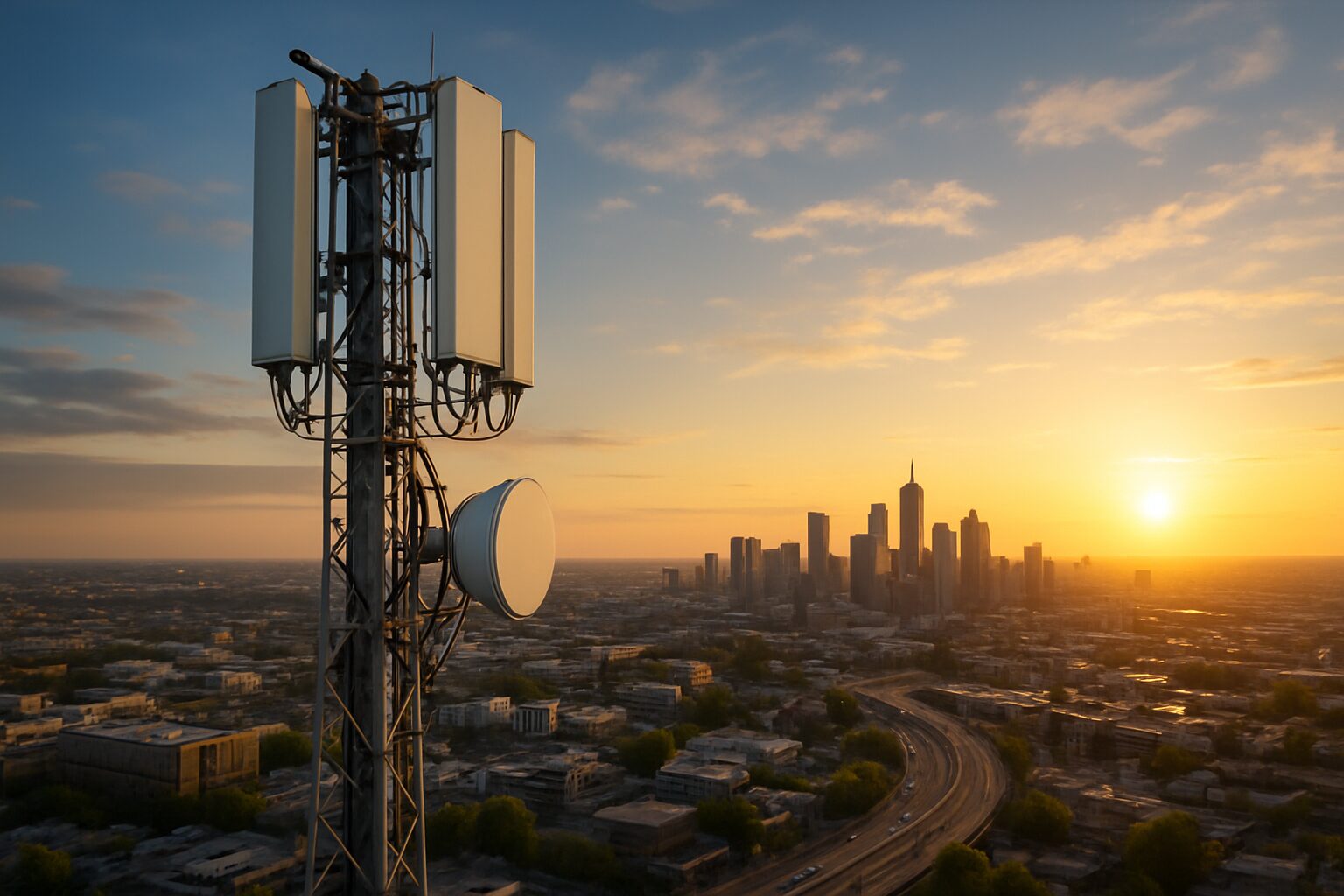
The world today runs on fast and reliable internet. From streaming videos to online classes, remote work, smart homes, and mobile apps, everything depends on stable connectivity. This is where 5G, or the fifth-generation mobile network, comes in.
In simple words, 5G is the newest mobile network technology designed to deliver faster speeds, lower latency, and better performance than 4G. It helps your phone load videos instantly, makes gaming smoother, and supports new technologies like smart cities and self-driving cars.
Why 5G matters today
We live in a time where:
- More people use mobile data
- More devices connect to the internet
- Apps and services require higher speeds
- Businesses rely heavily on online tools
With all these demands, older networks like 3G and 4G can’t always keep up. 5G helps solve this problem by giving us faster, bigger, and smarter networks.
How 5G differs from older generations
| Generation | Main Feature | Speed |
|---|---|---|
| 2G | Text messaging | Very slow |
| 3G | Basic mobile internet | Slow |
| 4G/LTE | Fast mobile internet | Fast |
| 5G | Ultra-fast, low-latency, high-capacity | Very fast |
This guide will explain what 5G is, how it works, its benefits, challenges, real-world uses, and what the future looks like.
What Is 5G?
Meaning of the “5th Generation Mobile Network”
5G simply means the fifth major improvement of mobile network technology. Every generation brought something new:
- 1G – Voice calls
- 2G – Text messages
- 3G – Basic internet
- 4G – High-speed internet
- 5G – Very fast, low-latency, intelligent connectivity
Evolution from 1G to 5G
Technologies improved massively over time. With 5G, networks can now handle much more data and connect millions of devices at the same time.
Main goals of 5G technology
- Faster download and upload speeds
- Lower latency (near real-time response)
- Better reliability
- Support for billions of smart devices
- Improved energy efficiency
Key improvements over 4G
Compared to 4G, 5G offers:
- Up to 100x faster speeds
- 1 millisecond latency
- 10x more network capacity
- Better performance in crowded places
How 5G Network Technology Works
5G technology works by using advanced radio waves, higher frequency bands, and more efficient network architectures to transmit data faster and with lower latency than previous generations. Unlike 4G, 5G uses millimeter waves for high-speed transmission, small cells to provide coverage in dense areas, and Massive MIMO (Multiple Input, Multiple Output) antennas to handle more devices simultaneously. Data is routed through fiber-optic backbones and edge computing nodes, reducing delays and improving responsiveness. These innovations allow 5G to support high-definition streaming, real-time gaming, smart cities, IoT devices, and other applications that require fast, reliable connectivity.
Why is 5G important?
5G is important because it revolutionizes connectivity by providing faster speeds, lower latency, and the capacity to connect millions of devices simultaneously. This makes everyday activities like streaming, gaming, and video calling smoother and more reliable. Beyond consumer use, 5G is critical for industries and smart technologies, enabling autonomous vehicles, remote healthcare, smart cities, and the Internet of Things (IoT) to operate efficiently. By supporting real-time data transmission and advanced applications, 5G lays the foundation for innovation, economic growth, and a more connected digital future.
Key Features and Benefits of 5G
Here are the major advantages of 5G networks:
1. Faster Internet Speeds
5G can deliver 1–10 Gbps, which means:
- Videos load instantly
- 4K/8K streaming becomes easy
- Apps download in seconds
2. Low Latency for Real-Time Communication
Latency is the delay before data travels.
4G latency = 50 ms
5G latency = 1 ms
This benefits:
- Online gaming
- Remote surgery
- Self-driving cars
- Live streaming
3. High Network Capacity
5G can support 1 million devices per square kilometer, making it useful in:
- Malls
- Concerts
- Stadiums
- Smart cities
4. Better Connectivity in Crowded Places
Even when thousands of people use the network at once, 5G stays stable.
5. Supports Massive IoT
5G connects smart home devices, sensors, appliances, and industrial equipment.
6. More Reliable and Efficient
5G minimizes network failure and improves energy efficiency, which helps telecom companies and consumers.
Types of 5G Deployment
There are two main types:
1. Non-Standalone 5G (NSA)
- Uses 4G as its backbone
- Faster and easier to deploy
- Most countries started with NSA
2. Standalone 5G (SA)
- Pure 5G infrastructure
- Much lower latency and more advanced features
- Supports smart cities and industrial automation
Which is better?
- NSA = more available, but less powerful
- SA = full 5G experience
Real-World Applications of 5G
5G is more than just fast internet—it enables new technologies.
1. Enhanced Mobile Broadband
Better video streaming, video calls, and content creation.
2. Smart Homes and Smart Cities
5G powers:
- Smart traffic lights
- Connected CCTV cameras
- Environmental sensors
- Smart appliances
3. Autonomous Vehicles
Self-driving cars need instant communication.
5G helps cars send and receive data in real time.
4. Remote Healthcare and Surgery
Doctors can guide surgeries from another location using low-latency 5G connections.
5. AR/VR Experiences
5G makes virtual reality smoother and more immersive, useful for:
- Gaming
- Training simulations
- Education
6. Industrial Automation
Factories use 5G to run robots, sensors, and machinery.
7. Gaming and Cloud Computing
Gamers get lag-free gameplay and quick streaming from cloud servers.
Challenges and Limitations of 5G
While 5G is powerful, it still has challenges.
1. Infrastructure Requirements
Many small cells and new towers must be built.
2. Limited Coverage in Some Areas
Rural areas may have fewer 5G towers.
3. Device Compatibility
Not all phones support 5G.
4. Interference Issues
High-band 5G has trouble passing through walls and buildings.
5. Higher Deployment Cost
Telecom companies must invest billions to upgrade networks.
6. Health and Security Concerns
There are myths about 5G, but:
- 5G signals are safe
- They follow strict global safety standards
- No scientific evidence links 5G to health risks
5G vs 4G: A Side-by-Side Comparison
Here’s a simple comparison:
| Feature | 4G | 5G |
|---|---|---|
| Speed | Up to 100 Mbps | Up to 10 Gbps |
| Latency | 30–50 ms | 1 ms |
| Capacity | Medium | Very high |
| Use Case | Phones | IoT, cars, cities |
| Energy | Less efficient | More efficient |
Visual: 5G Speed vs 4G Speed Chart
Speed Comparison (Mbps)
| 5G: ████████████████████████████████████████████████ 1000+
| 4G: ███████████ 100
(Graph simplified for text display)
Future of 5G Technology
5G-Advanced
Coming soon, bringing:
- Faster speeds
- Better coverage
- More energy-efficient networks
Innovation Areas
- Drone deliveries
- Holographic calls
- Smart agriculture
- Connected factories
Transition to 6G
6G is expected around 2030, offering:
- Holograms
- Digital twins
- Even faster speeds
What consumers can expect
- More 5G-ready devices
- Cheaper 5G phones
- Wider coverage
What was the real-world impact of 5G technology?
The real-world impact of 5G technology has been significant, transforming both consumer experiences and business operations. For individuals, 5G enables faster downloads, smoother streaming, and near-instantaneous online gaming, making high-quality media and real-time applications more accessible. In industries, 5G supports smart factories, autonomous vehicles, remote healthcare, and IoT devices, allowing businesses to automate processes and respond to data in real time. Cities are also benefiting through smart infrastructure, improved traffic management, and enhanced public safety systems. Overall, 5G is not just faster internet—it’s creating a more connected, responsive, and efficient digital world.
Conclusion
5G network technology represents the next generation of wireless communication, offering faster speeds, lower latency, and greater capacity than previous networks. By using advanced technologies like millimeter waves, small cells, and massive MIMO, 5G can support more devices, enhance streaming and gaming experiences, and enable innovations like smart cities, autonomous vehicles, and IoT applications. Understanding how 5G works helps users and businesses appreciate its potential impact on everyday life and the future of connectivity. As adoption grows, 5G is set to transform how we communicate, work, and interact with technology.
Frequently Asked Questions (FAQs)
1. What does 5G stand for?
It stands for “fifth-generation mobile network.”
2. How fast is 5G?
5G can reach up to 10 Gbps, depending on location and network type.
3. Is 5G dangerous?
No. It follows strict global safety standards.
4. Does 5G work on all phones?
No, only 5G-enabled phones can use 5G networks.
5. Is 5G available everywhere?
Not yet. Cities have better coverage than rural areas.
6. What is 5G used for besides phones?
Smart homes, IoT, autonomous cars, VR, healthcare, and more.
7. Is 5G better than Wi-Fi?
Both have different uses; 5G is mobile, while Wi-Fi is local.
8. Will 5G make my internet more stable?
Yes, especially in crowded places.
9. Does 5G replace 4G?
Not immediately. Both networks work together.
10. Is 6G coming soon?
Expected around 2030, still in early development.
Disclaimer
This article is for informational purposes only. Technology, network coverage, and performance may vary depending on your location, device, and telecom provider. Always check with your local network operator for the most accurate and updated information.


It’s interesting to see how 5G aims to improve connectivity for things like remote work – I found some related information about network optimization on https://hypackelgames.com/games/geometry-dash while researching this topic.
The focus on fast-paced, intense multiplayer action sounds promising for an arcade title. I found a few more details about the different weapon types on https://hypackelgames.com/games/crowd-battle-gun-rush.
The no-download, no-registration feature is definitely a huge plus for mobile gaming. I was wondering if the easy controls mentioned here are similar to the system outlined on https://hypackelgames.com/games/mini-car-racing-master-3d.